
Just a short introduction on (1) the label, (2) the projects involved, and (3) the specific recording details, before getting over to the aural essence. Winter-Light is quite a young label from the Netherlands (with Anglo-Saxon roots); or better: it’s not such ‘new’ label anymore, yet as from a couple of years it is about to become one of the most prominent labels within the Dark Ambient / Drone (and so forth) scene. It’s run by the mostly sympathetic human being Mark O’Shea, by the way.
Naiad is a collaborative effort by two great (Ambient) projects managed by two of the most notorious sonic wizards from Flemish soil: Ashtoreth and Penumbral Aethyr, run by, respectively, Peter Verwimp and Nicolas Van Meirhaeghe. The first one (Peter) did release some material before via Winter-Light; the latter (Empusae’s Nicolas) joins the label for the first time. Both of them did write, record and produce the four lengthy chapters, not using audio plug-ins, just field-recordings, voices, electroacoustic sources and hardware (and I have to admit that this last phrase is loosely ‘stolen and reinterpreted’ from the additional information on the label’s page). The mastering duties, by the way, were done by Ronald Mariën, who’s not a label’s stranger at all as ‘master’, and who worked with Ashtoreth before on the Between Worlds album (2020, also on Winter-Light).
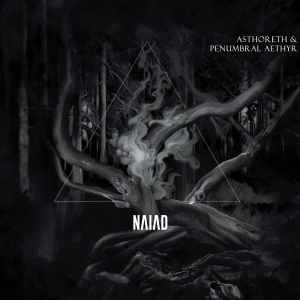
The result is available digitally, evidently, as well as physically; this one being a so-called glass-mastered digipack CD, printed in an edition of three hundred copies. It comes with fine visual artistry, courtesy of Nesisart aka Christel Morvan - a close acquaintance of Nicolas, by the way. It’s like a smoke-covered tree in an hostile forest, standing before a secret portal towards some unknown dimension. The smoke relates, I think, to the result of fire and water, with water being referred to the unconsciousness behind reflection and emotion; hence the title ‘naiad’. Also the in-lay artwork, black-and-white photographic visions of trunks, shining in its soberness, defines the skilled work of this damsel.
The four orchestrations are inspired by ancient godlike creatures who represent emotional expressions at the one hand, and a mythologically and culturally human view on fear, wisdom and insight at the other hand: Boreas, Nephthys, Naiad and Ptah, in this order of appearance. In ancient Greek mythology, Boreas was an ‘anemoi’, a god of winds, representing the rough, devastating Northern winds. He was referred to as bringer of darkness, storm and winterly coldness (snow and ice winds). Nephthys aka Nebet’het then again comes from the Egyptian mythology. She was one of the Enneads (the earliest gods) and was considered the goddess of mourning and dusk, protector of the Dead, and involved with birth and protection, as well as the netherworlds (cf. the aforementioned Dead). She was (and this is, of course, purely informative, yet quite interesting, to my humble opinion) the sister of Isis, Seth and Osiris, and mother of Anubis (Seth was Anubis’ father, by the way). Naiad, whose mythos inspired Nicolas and Peter to ‘use’ as working title for this album, refers to the cosmos (it’s one of Neptune’s moons) as well as to Water as one of Earth’s essential elements. Naiads were water nymphs, comparable to our own ‘undines’, which were related to rivers, lakes, wells, ponds, even swamps, and the healing (and sometimes destructive) power of water. Ptah, finally, was a primordial godlike entity in the Egyptian mythology, creator of mankind, and responsible for the art of forging, sculpting and pottery (mankind was born out of his clay generation).
This said… A small word about the sonic side of the four hymns on this album, which mytho-historic sources were sort of summarized in the former paragraph.
Boreas is, with its length of just under eight minutes, the shortest piece on Naiad. As from the bare beginning, the ritualistic ‘core’ gets revealed: mesmeric drones and ethnic / spiritual percussions, soon ‘joined’ by dreary voices, are like the spine of a musical meditation. The whole permanently expands in aural abundance, with more layers of ‘hardware’ and additional traditional percussions (wind bells, gongs, bowls etc.) rising from the deep. Boreas is veiled in a dense, dim nebula of introspective, even illuminating gloom, like the vision of a distant point of light, far away, which seems unreachable somehow, yet which still, even-though modestly, enlightens the fog that covers the listener’s being.
Nephthys (09:26) opens in a scarifying way, through field-recorded sounds and percussions, and a haunting keyboard-like tune. Slowly the whole unfurls towards an obscure, obfuscating solemnity, like a trip that guides through fascinating yet oppressive dimensions of the soul. It represents doom, emptiness, vastness and the unphysical beauty of transition. Because of the lingering tempo, the haunting voices and the eldritch percussions, this song works paralyzing.
The title track, which clocks 13:37 minutes, delves into even greater territories of confrontation and revelation. Once again created around spooky synths, bizarre percussions, diverse yet carefully used Field Recordings (I adore the subtly used singing birds), manifold voices, and other narcotic-injected electroacoustic elements, yet drenched by suffocating – why not: Lovecraftian – instrumentation and vocalization; disturbing drums, dissonant structures, confusing soundwaves and, on top of it, fragments of ethnic and ceremonial nature. Delusion and perfidy of Life’s holiest secrets inevitably will lead to oblivion.
The album ends with Ptah (09:16), offering us an in-depth shamanistic symphony of transcendental authority. The omphalos is initially established around horrific sound-sculpting (the aforementioned percussions, samples and digital wizardry), with a mechanoid sound-palette (read: tone and mood had that hint of industrial impendence). More than before, the field-recorded elements and rumbling drones work menacing and suffocant. At four minutes, Ptah shifts towards another level of emotional-introspective phantasm, with this fine equilibrium of esoteric chants, lugubrious ambience and somehow ritual-laden shades of trans-dimensional grandeur.
All four pieces are closely related, with an inner coherence that defines the essence of the Naiad concept. At the other hand, each single chapter section exhales its own scent of musical finesse. This effort stands for chaste and substantial Dark Ritual Drone Ambient Music, or whatever one might call it like… And I acknowledge that this release is not ‘new’. Naiad was released almost one year ago, and Winter-Light did release a handful new (magnificent) recordings in the meantime, but I cannot but emphasize the sonic magnificence of this collaborative effort called Naiad. High(ly) recommended!!!
https://winter-light.bandcamp.com/album/naiad
https://www.winter-light.nl/our-releases/ashtoreth-penumbral-aethyr-naiad
https://www.concreteweb.be/reviews/ashtoreth-no-one
https://www.concreteweb.be/reviews/various-artists-rituals-ancient-europe
https://www.concreteweb.be/reviews/various-artists-cycles-ii
https://www.concreteweb.be/reviews/empusae-klankdal
https://www.concreteweb.be/reviews/onus