
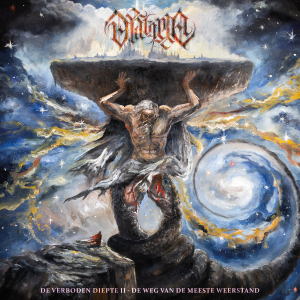
About twenty years ago, Pulverised members Dennis Onsia and Cees De Wit decided to start a side-project, next to their leading Death Metal act, in order to canalize the rather Thrash Metal ideas they had at that moment. Thus Dystopia was born. After a short hiatus, they evolved towards a more Blackened Death Metal oriented act, and throughout the years, their approach got more and more technical and complex.
Enter 2024. The band released their fourth full length, called De Verboden Diepte I: Veldslag Op De Rand Van De Wereld (which is Dutch for ‘the forbidden depth 1: battle on the edge of the world’), with Dennis (voices and guitars; music) and Cees (drums, as well as the lyrics) being joined by Thomas Cochrane (guitars and backing vocals, trumpet and trombone; also responsible for mix and engineering) and Rick Jongman (strings; he joined the band after their break in 2011).
With the very same line-up, Dystopia return with De Verboden Diepte II: De Weg Van De Meeste Weerstand (‘the forbidden depth 2: the way of the most resistance’). In the vein of the past, the ‘songs’ are lengthy, but this time it is a real defiance, for there are just two compositions, despite a total duration of more than thirty three minutes (!): Confrontatie (‘confrontation’) clocks 14:17 minutes, De Ultieme Roeping (‘the ultimate calling’) almost nineteen minutes (18:51).
Confrontatie starts with an eerie ambient introduction, but soon expands into more intense territories. At first quite ‘traditional’ in execution, quickly the highly technical characteristics of the band show up. Dissonant chords, contradictory drum patterns, and complex breaks get introduced within the epic and atmospheric Black Metal basics. The song includes multiple changes in structure and tempo, with slower passages interacting well with up-tempo pieces, pierced by blasting eruptions. Further on, also elements of Epic (Viking-inspired) Black Metal, Post-Black Metal and even Doom Black Metal get used to define this band’s unique sound. But there’s so much more to explore. At almost five minutes, for example, another typifying element reappears: the sad-sounding Doom-Brass drenched trumpet. Together with the eccentric drum salvos and oddish strings, it adds a Jazz-like hint somehow. Hints of Sludge at ten minutes; that majestic solo at almost twelve minutes, soon followed by an overwhelming Pagan excerpt; and so on. The diverse vocal lines too – with lyrics in Dutch (works very well!) – are a characteristic detail; no, it’s much more than a detail, of course: growling shouts, evil yells, deep screams, spoken words; it’s all part of the whole experience. Even some choirlike chants appear (in the second song).
Initially, De Ultieme Roeping is a frensy beast-of-noise: fast, uncompromising, intolerant and militant in essence. but here too, evidently, nothing remains predictable. Permanently shifting in tempo and texture, this composition is a challenge, an adventure, a beseech for endurance. Sometimes orchestral, then again dreamlike, victorious (cf. the main riffs in the first quarter), mysterious, or just brutal like in taking-no-prisoners, there’s always something exceptional to perceive. Particles of NWOBHM, Melo-Death, DSBM and different types of traditional or more contemporary Black Metal, are all mingled up to a prodigious encounter. Mind that integer acoustic (coming right after the aforementioned choir-singing) excerpt at about eight minutes, cinematic and atmospheric in nature, mysterious and mesmeric in atmosphere, slowly evolving into a mighty symphony with those trumpets / trombones and synths (I guess), like an operatic upheaval (and eventually exploding with a mostly fierce and fiery blasting fragment of scenic rage. And it does not end this way; more passages of Doom, Blast and Post pass by, again and again.
The thing is, despite the multiplicity of approaches, tempos and structures, as well as the countless additional elements (acoustics, symphonic parts, Brass elements, medieval and epic details, and so on) and the massive variety in sphere and attitude, that the whole still sounds cohesive, like one huge single monument of soundscape. That’s a unique strength, courtesy of Dystopia. Therefor: highly recommended!
The album was recorded (at the E-Sound Studio) and mixed (TC Music Productions) by Thomas, and once again the mastering was done at Audiosiege by the famous Brad Boatright. It might be evident that the quality of the sound is top-notch, for it is more than decent in production, perfectly balanced within the mix, and still coming with a fine-tuned hint of unpolished rawness.
Besides the digital version, there is a compact disc edition, i.e. a digipack that comes with a twenty-four paged booklet, as well as two vinyl types, including an insert with the lyrics. It comes with remarkable artwork by Mister Ronarg (the color palette is totally comparable to the first album in the De Verboden Diepte series), with artwork and layout done by Immortal Frost Productions’ long-time partner WrathDesign.
https://www.concreteweb.be/reviews/dystopia